 John Alex
If you’ve ever typed “strategic browser game” into Google and felt a bit lost in a sea of generic city builders and timer-clickers, you’re not alone. The browser strategy genre is packed with games – but a lot of them feel very similar once you get past the splash screen.
At the same time, there are titles that really try to push the idea of what a browser-based strategy game can be. One of the more interesting recent examples is WarFrontline – a free-to-play WW2 strategy game played entirely in the browser, built around a massive hex map and long-term multiplayer campaigns.
Below, we’ll look at WarFrontline in the context of other well-known war and strategy browser games such as Call of War, Wargame 1942 and classic MMORTS-style titles.
What defines a good strategic browser game in 2025?
Before comparing individual titles, it’s worth asking: what should a strategic browser game offer today?
From a player’s point of view, some fundamentals are pretty clear:
- No installation required – a true browser experience: open a tab, log in, play.
- Meaningful decisions – your role is to plan, prioritize and manage, not just click through shiny buttons.
- Persistent world – games that evolve over days and weeks, not just 5-minute rounds.
- Multiplayer focus – alliances, diplomacy and player-driven stories.
- Reasonable free-to-play model – paying is optional, not mandatory for basic competitiveness.
Now let’s see how WarFrontline fits into that picture.
WarFrontline – a WW2 strategic browser game built around a living front
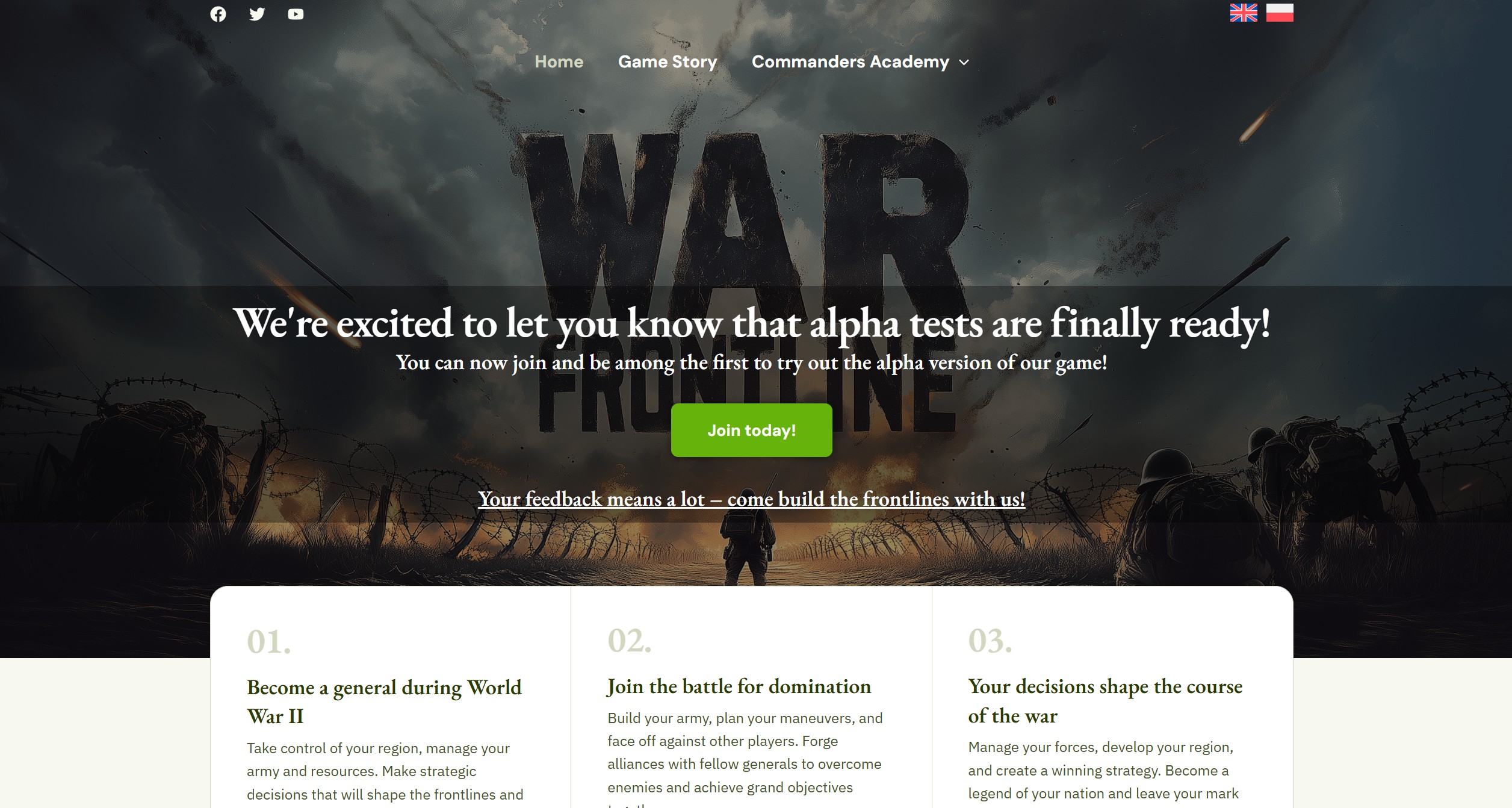
WarFrontline is a free-to-play, browser-based strategy game set during World War II. Its first campaign is focused on Operation Barbarossa – the German invasion of the Soviet Union – and lets players join either Germany or the USSR.
What instantly sets WarFrontline apart:
- It uses a large hexagonal map, where every tile represents a piece of territory to fight for.
- It leans heavily into wartime economy and logistics (fuel, steel, ammunition, manpower).
- It’s built for multiplayer cooperation – you’re fighting as part of a nation, not a lone city in the middle of nowhere.
You log in via browser, manage your region, build infrastructure, secure resources and support your side of the front. There’s no client download; WarFrontline is a genuine strategic browser game, not a PC title disguised as one.
WarFrontline vs other WW2 browser strategy games
There are several WW2-themed strategy games available in the browser today – e.g. Call of War and Wargame 1942 – so it makes sense to ask what WarFrontline does differently.
1. Map design: hex-based frontline vs big political map
- Call of War presents WW2 on a large political map with countries and provinces. You take control of a nation, conquer provinces and build up your economy in a Risk-like fashion.
- Wargame 1942 also uses a more traditional province/economy structure, where you expand a base and wage war via menus and overviews.
WarFrontline goes another route:
- The entire battlefield is a hex grid, more like a digital wargame than a casual MMO.
- Each hex can host units, infrastructure or key resources (like oil or industrial areas).
- The frontline is literally visible – push it forward hex by hex, or desperately hold key tiles to avoid a breakthrough.
If you enjoy board games or classic hex-wargames, this is a big deal: you’re not just seeing “a province changed color”; you’re watching a real front swell and contract.
2. Focus: your own empire vs shared national effort
Many classical titles in this space – from Call of War to Supremacy-style games – centre on your personal country: you are the nation, and everyone else is a rival state trying to dominate the map.
WarFrontline takes a slightly different angle:
- You join a side of the conflict (Germany or USSR in the current campaign).
- You manage a region within that nation.
- Your job is to strengthen your sector, support offensive or defensive operations and contribute to the overall war effort.
Instead of “me versus 99 other players”, the feeling is much closer to:
“We’re holding this front together – if I mess up my sector, my teammates will feel it.”
That makes WarFrontline feel less like a pure 1v1v1v1 war and more like a cooperative grand campaign.
3. Economy and logistics: more than just generic resources
Most strategy browser games give you a few generic resources: food, wood, gold, maybe oil. They matter, but often only as numbers to unlock the next building.
In WarFrontline, the resource system is explicitly shaped around war logistics:
- Fuel – without it, your mechanized units are stuck.
- Steel – required for producing equipment and infrastructure.
- Ammunition – essential for sustained fighting.
- Manpower – the pool of people you can actually send into the field.
Controlling certain hexes gives you better access to key resources – capturing an oil-rich region genuinely impacts how long you can maintain offensive operations. Losing an industrial hub is felt in production. This is what makes WarFrontline feel like a true strategic browser game, not just a skinned city builder.
Compared to classic browser MMORTS games
Beyond the WW2 niche, there’s a long tradition of browser MMORTS games: Stormfall: Age of War, Ministry of War, Vikings: War of Clans and many others.
They share certain traits:
- Build and upgrade your town/castle/city.
- Train troops in queues.
- Join a clan, attack neighbours, defend resources.
- Often, a rather aggressive monetisation model with time-skips and boosts.
WarFrontline shares some DNA (long-term development, alliances, cooperative warfare), but it clearly leans toward historical wargame rather than fantasy city-builder:
- You’re not growing a kingdom of dragons or Vikings – you’re navigating a very grounded WW2 front.
- The central visual is the frontline map, not a personal town screen.
- Decisions are framed in terms of operations, supply and territory instead of castles and magic.
If you’ve enjoyed older MMORTS games but want something more tactical and historically grounded, WarFrontline is a refreshing direction.
Is WarFrontline pay-to-win?
A question every strategy player eventually asks is: “Will I get crushed just because someone else spends more money?”
According to the game’s own FAQ, WarFrontline is free-to-play and the monetisation plan explicitly avoids unfair advantages – the goal is to keep the playing field balanced and competitive.
That matters. Many long-running browser games have developed reputations for heavy pay-to-win systems. WarFrontline is positioning itself as:
a strategic browser game where planning, teamwork and logistics should matter more than your wallet.
For players burned out on overly monetised titles, this is a strong selling point.
Who will enjoy WarFrontline the most?
Given all of the above, WarFrontline is likely to click with a few specific player types:
1. Fans of historical WW2 strategy
If you like games that take WW2 seriously as a setting – big fronts, national economies, grinding offensives – WarFrontline is built exactly around that. The initial focus on Operation Barbarossa means the entire design leans into the Eastern Front’s scale and brutality.
2. Players who love hex maps and wargames
The hex grid is not just for show. It shapes how you think about:
- Defence lines,
- Encirclements,
- Narrow corridors and chokepoints,
- Logical supply routes.
If board wargames or digital hex-based titles are your thing, seeing that design brought into a multiplayer browser game is a big plus.
3. Strategy gamers with limited time (but long attention span)
WarFrontline, like other good strategic browser games, doesn’t demand that you sit for 4 hours straight. Instead, you:
- log in a few times a day,
- adjust production,
- plan your moves,
- coordinate with your allies,
and then let the campaign continue to unfold.
If you’ve grown out of all-night LAN sessions but still love deep strategy, this style of play is ideal.
Why WarFrontline is worth a look if you’re searching for a strategic browser game
There are many browser games marketed as “strategy”, but relatively few that really embrace the full meaning of the term. WarFrontline is one of the rare projects that tries to combine:
- Browser simplicity – no download, just log in and play.
- Historical depth – a specific WW2 campaign instead of a generic “war setting”.
- Hex-based tactics – frontlines that look and feel like a real operational map.
- Multiplayer cooperation – fighting as part of a larger nation, not only for yourself.
- Fair free-to-play philosophy – planning and coordination are the core, not credit card duels.
If you’re tired of shallow “strategy” skins and want a strategic browser game that actually cares about maps, supply, allies and long-term campaigns, WarFrontline is absolutely worth putting on your radar – and in your bookmarks.
For More Update and Stories Visit: The Europe Times