
 John Alex
For a business that relies on online search, links from other websites can help people discover its work and help search engines understand its place in the wider web. But not every link is useful, and a sudden rush of dubious links can raise understandable concerns. The challenge is separating genuinely manipulative activity from the ordinary messiness of the internet—and responding without damaging a site that is performing well.
Why backlinks still matter
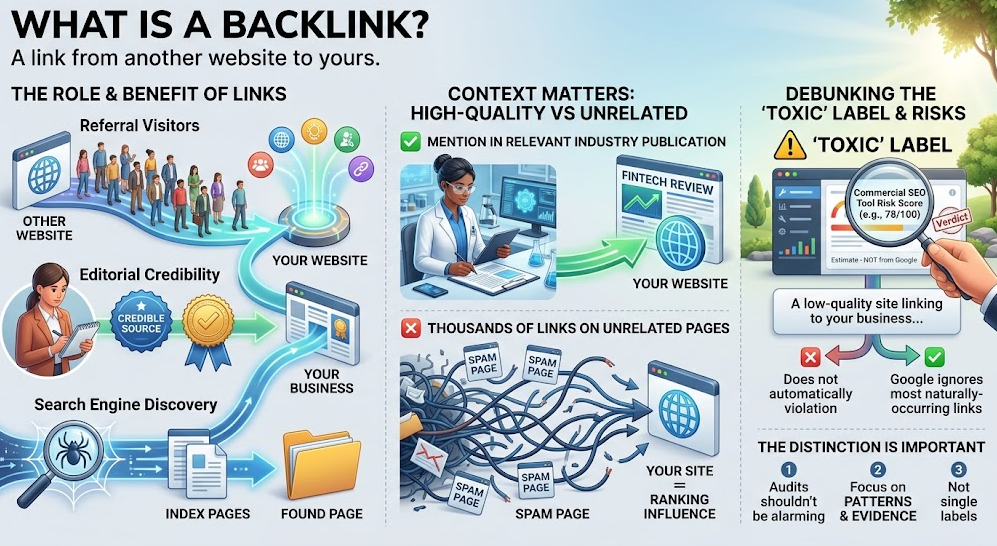
A backlink is a link from another website to yours. Links can bring referral visitors, support editorial credibility and help search engines find pages. A mention in a relevant industry publication is very different from thousands of links placed on unrelated pages purely to influence rankings. The context, source and reason for the link all matter.
That distinction is important because the word “toxic” can make a routine audit sound more alarming than it is. Some commercial SEO tools assign risk scores to links, but those scores are estimates—not a verdict from Google. A low-quality site linking to your business does not automatically mean your site has violated search guidelines. Focus on patterns and evidence, not a single label.
Recognising links that deserve a closer look
Warning signs may include links created through paid schemes that pass ranking credit, private networks built mainly to manufacture links, or large numbers of automated links using the same keyword-rich anchor text. Links on unrelated pages with little genuine content can also warrant investigation, especially when they appear in volume or alongside other signs of a coordinated campaign.
By contrast, a small blog, an old directory listing or a foreign-language site is not necessarily harmful. Websites vary in quality, and a link can be irrelevant or ineffective without being manipulative. Ask whether there is a plausible editorial or business reason for the link, whether the surrounding page is credible, and whether the pattern suggests deliberate ranking manipulation.
A measured process for auditing backlinks
Start by gathering data from more than one source. Google Search Console provides a view of links Google has identified, while third-party tools can help uncover additional domains and historical patterns. No database is complete, so treat the combined results as evidence to assess rather than a definitive list of offences.
- Look for patterns. Group links by referring domain, anchor text, page type and date. A burst of repetitive links is more informative than an isolated low-quality result.
- Review the source pages. Check whether the pages exist, contain meaningful material and link in a context that makes sense. Consider how the links were acquired and whether anyone in the organisation commissioned them.
- Prioritise credible risks. Record the domains or URLs that appear connected to a clear paid or manipulative scheme. Keep notes on the evidence and the steps taken.
- Request removal where practical. If you can identify a site owner or contact address, make a concise, polite request to remove the link or apply an appropriate link attribute. Keep a record, but do not spend weeks pursuing every unreachable site.
For a practical overview of how to assess and address harmful links, it helps to understand both the warning signs and the limits of cleanup tools. A review is most useful when it is tied to a clear concern, such as a manual action notice or convincing evidence of a link scheme—not simply a disappointing score in an SEO platform.
When to consider Google’s disavow tool
Google’s disavow tool is not a routine housekeeping feature. Google says most sites do not need to use it, because its systems can generally assess links without a site owner disavowing individual domains. Using it carelessly may tell Google to ignore links that were not actually causing a problem.
It may be appropriate when there is a substantial volume of artificial, spammy or manipulative links and a manual action has been issued, or when there is a strong likelihood of one. Before submitting a file, review it carefully, preserve a copy and understand that disavowal is not an instant fix or a guarantee of ranking recovery. If a manual action is involved, the site owner should also address the underlying practices and follow the reconsideration process.
Preventing a repeat—and getting the right help
The best cleanup is often avoiding the problem in the first place. Be wary of providers promising a fixed number of links or guaranteed positions. Ask how links will be earned, what sites are being approached and whether the approach prioritises useful editorial coverage over volume. Keep access to reporting and make sure whoever commissions work understands the difference between outreach and schemes designed to manipulate rankings.
Smaller businesses may need occasional specialist support without employing a full-time SEO team. A freelance marketplace such as Osdire can be one place to find independent professionals across marketing and other fields. As with any hiring route, check a freelancer’s relevant experience, agree the scope and deliverables in writing, and retain control of your website and search accounts.
A careful backlink audit is not about trying to erase every imperfect mention of a business. It is about identifying credible evidence of manipulation, taking proportionate action and building a more sustainable approach to online visibility. That measured response protects both search performance and the time businesses can spend on work that genuinely serves their audience.











Follow